Last updated on June 18th, 2025
Are you planning to take a first class Vietnam sleeper train? In this guide we’re sharing how to book, cabin options, what to expect on the train, and our personal experience.
In the United States, train travel isn’t a very common way to get across the country. So one of our bucket list items that we wanted to experience while in Vietnam was taking an overnight train ride.
We boarded a 17 hour train from Ho Chi Minh City to Da Nang in a first class cabin. And it was an experience!

Watch the highs and lows of our experience on a first class Vietnam sleeper train from Ho Chi Minh City to Da Nang!
We had an uninvited tiny guest, confusion with food, and not much sleep. But we also witnessed the beautiful countryside of Vietnam that we wouldn’t have seen otherwise. The 17 hours were full of highs and lows, but overall, we are extremely glad we did it and made some memories we will never forget.
And in this guide our goal is to share everything you need to know before taking a Vietnam sleeper train. Like how we snagged a special two person first class cabin! We’re also giving a very honest take on what to expect, plus a list of items to bring with you and so much more.

- Why should you take a sleeper train in Vietnam?
- About Vietnam’s Reunification Express Train
- Train routes in Vietnam
- Vietnam Sleeper train cabin and seating options
- How to book Vietnam sleeper train tickets
- What to expect on board a Vietnam sleeper train
- The best part of the Vietnam sleeper train: the scenery
- Getting off at your destination
- Frequently asked questions about Vietnam sleeper trains
- Things to know for riding a Vietnam sleeper train
- What should you bring on a Vietnam sleeper train?
Why should you take a sleeper train in Vietnam?

Before we begin, we think it’s important to share why we think you should take a sleeper train in Vietnam. Throughout this guide we will share parts of our experience that may make you question taking one. But even though our experience wasn’t perfect, we are big fans of train travel.
We rode the train in Vietnam four times during our almost six weeks in the country. The first time was an overnight train from Ho Chi Minh City to Da Nang, while the other times were quite a bit shorter.
Here are some pros (and cons!) to train travel in Vietnam!
Pros
- It can be a lot cheaper than taking a plane, tour, or limo (what they call a van) to different destinations.
- You have much more space to spread out and walk around than an airplane.
- The scenery is amazing! You will get to see parts of Vietnam you wouldn’t have otherwise.
- For longer journeys, you can have a bed to sleep in, which beats the heck out of sleeping on a plane. It also covers your accommodation costs for the night!
- It is a unique experience and more of an adventure than flying.
- It can take you to some of the best cities to visit in Vietnam like Ho Chi Minh City, Nha Trang, Da Nang, Hue, Ninh Binh, and Hanoi
Cons
- It can take a lot longer than flying, especially for the overnight routes. Ex: Ho Chi Minh City to Da Nang was 17 hours by train vs. 1.5 hours by plane. Quite the difference!
- Cleanliness can be questionable at times. We will share more about this later!
About Vietnam’s Reunification Express Train

Vietnam’s train system was originally built by the French in the 1880s and has developed over the years.
The most well known train route in Vietnam is the Reunification Express, which is operated by Vietnam Railways. This isn’t a single train, but refers to one of the many trains that travel on the north-south route between Ho Chi Minh City and Hanoi.
Throughout the many years Vietnam was at war, the rail line was damaged thousands of times. After 1975, the Vietnamese government unleashed a major development project to repair the rail line. This achievement was a symbol of a reunified Vietnam, giving it the name the Reunification Express.
Today, there are a variety of trains available in Vietnam, ranging from very basic to more luxurious. But for this guide, we’ll exclusively be covering the Reunification Express train, as that is the only one we have experience with.
The Reunification Express is considered to be the authentic, local way to travel by train in Vietnam. It is very basic, but offers a variety of seating options, has food, and multiple toilets. If you are looking for train options more catered to tourists, Lotus Train, Violette, and Vietage all have multiple routes in Vietnam.
Train routes in Vietnam

The main route for the Reunification Express runs from south to north, from Ho Chi Minh City to Hanoi, which takes between 33-36 hours! Along the way, the train stops in multiple popular destinations, like Nha Trang, Da Nang, Hue. And there are also separate lines that you can connect onto to reach other destinations!
Curious where all you can go via train in Vietnam? You can see the full train route here, but below are some of the most popular train route options:
Ho Chi Minh City to Hoi An: 17+ hour train ride to Da Nang, plus a 40 minute Grab/taxi ride
Da Nang to Huế: 2.5-3.5 hours (This is said by many to be the most scenic train ride in Vietnam, as it goes through Hai Van Pass)
Hanoi to Ninh Binh: 2 hours, 15 minutes
Hanoi to Lào Cai (Sapa): 8 hours
Hanoi to Haiphong (Cat Ba Island): 2.5-4 hours
Vietnam Sleeper train cabin and seating options
There are a variety of different cabins and seating options on Vietnam sleeper trains. From the most basic, barebones hard seats, all the way to private cabins. In this section we will go over each option, plus our experience with most of them!
Hard Seats
Hard seats are the cheapest ticket option on Vietnam trains. And they are what they sound like–a wooden bench with no padding. These benches are designed for three passengers, so you’ll be expected to share the bench with two others.
Some of the hard seat carriages have air conditioning, but not all. In the carriages without air conditioning, the windows can be opened.
Who this option is good for: Personally, we wouldn’t recommend this option if you can avoid it. While you’d save the most amount of money, sitting on a hard bench, even for a couple hours, would be pretty brutal.
Soft Seats

The next level up from hard seats are soft seats. These seats are basically like seats on an airplane. They have padding, a fold down tray table, and also recline a tiny bit.
The train cars are set up with two seats on either side, with some sections having two groups of seats that face each other (with a table in between). There is luggage storage above the seats, so you can hopefully keep your foot area as open as possible.
We sat in these when going to and from Ninh Binh to Hanoi and it worked fine! We were a bit spoiled by the sleeper cabins at this point, but for a shorter journey, it’s a great, cheap option.
Who this option is good for: We would suggest this seating option for any train ride under 4 hours, especially if during the day. It will give you a similar experience to being on a plane, but with more room to wander around the train. We wouldn’t suggest choosing this for an overnight train.
Hard Sleeper (6 berth)
The first type of sleeper cabins on Vietnam trains are hard sleeper cabins. These air conditioned cabins come with six beds, with three stacked on each side of the room.
Despite the name, these aren’t wooden beds. You will get a thin mattress, sheet, pillow, and comforter. Each bed will likely have a reading light and outlet to charge electronics. When you book your ticket, you’ll be able to choose which bed you want.
There isn’t much space between the bed or roof above you, so if you’re claustrophobic these might be a tough option.
Who this option is good for: This would be a good overnight option for a group, if you want to all be together. If traveling alone or in a smaller group, we’d only suggest this if it’s the last sleeper option available for an overnight train. Having a bed, even with many strangers, is better than a seat! Beyond overnight trains, this could be a good option for longer day train rides, if you want to be able to stretch out.
Soft Sleeper (4 berth)

Soft sleeper cabins are similar to the hard sleeper, but have two bunk beds, sleeping four people instead of six. The amenities are about the same otherwise, except we hear that the mattresses can be a bit thicker than the hard sleeper.
When you book you choose which bed you want. Many people consider the upper bunk the better of the two options. It’s slightly quieter and you have more privacy, but you do have to climb up and down, which wouldn’t be very fun in the middle of the night.
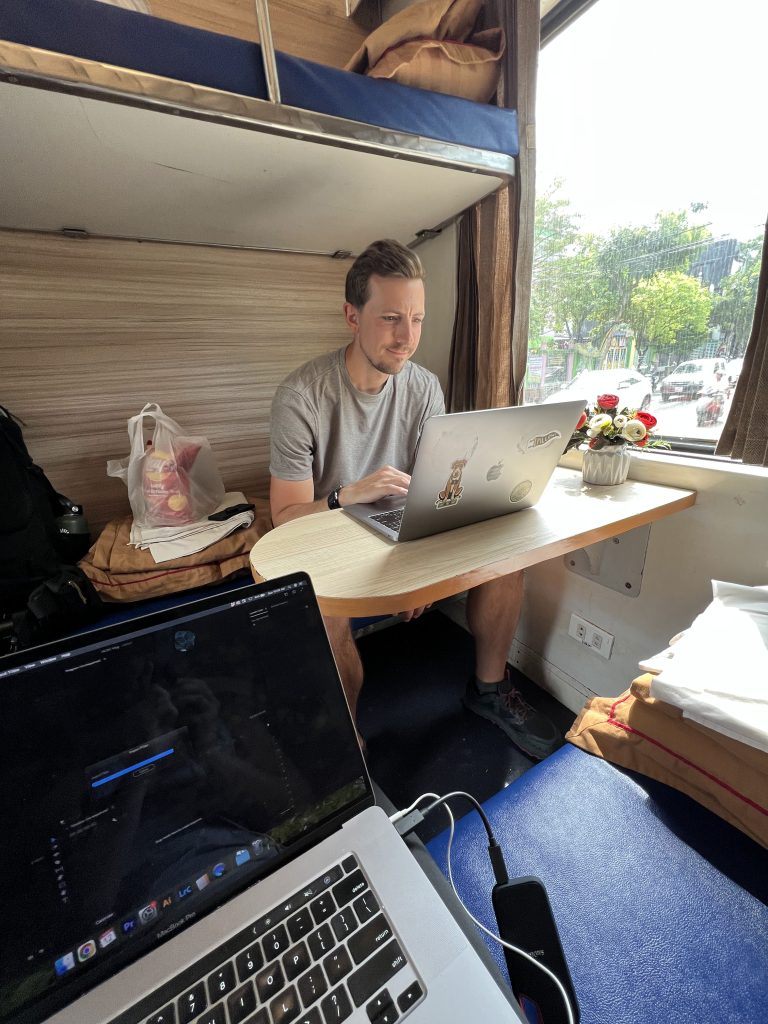
The lower bunk is easier to get in and out of and you’ll have access to a table. But be prepared, your cabin mate might sit with you on your bed during the day to share the table with you.
We had a soft sleeper on our train from Da Nang to Dong Hoi, which was almost 7 hours during the daytime. It was really nice to be able to lay down if we wanted or sit at the desk (we had bottom bunks) and work. Our cabin mates were very quiet and we hardly remembered that they were even above us!
Who this option is good for: This is a great overnight sleeper cabin option! With only four beds, you will sleep with less strangers (and they may not all be there the entire time). We also highly suggest this option for longer day trains. For a train 4 hours and above, this would be a lot more comfortable than the soft seats.
VIP (2 berth)

The VIP cabin is the prime cabin option for an overnight train in Vietnam. This cabin has only two beds, which means that you and your travel partner can have the entire cabin to yourself.
Similar to the other cabins, you’ll have two beds, sheets, comforter, and pillow. There were a handful of outlets, as well as multiple places to store our luggage. Ours came with some mugs and water bottles too!
Because of its privacy, it is the most expensive option. We booked this cabin for our 17 hour overnight train from Ho Chi Minh City to Da Nang. And it was well worth the extra cost!
Another important thing to know about this cabin is that it is not on all trains. It is only offered on a couple departure times and there are only a handful of these cabins on the train. Because of this, it has become a bit more difficult to book due to its limited quantity and higher demand. We’ll share our tips for snagging one in the next section of this guide!
Who this option is good for: This is the BEST option for taking a sleeper train in Vietnam. You will have the most amount of space, privacy, and comfort.
How to book Vietnam sleeper train tickets
Book online
While you can book your ticket directly through Vietnam Railways, we found the user experience to be lacking. We also could never figure out a way to book the VIP cabin on their website. Instead, we highly recommend booking your train on 12Go. This was our go-to website for booking trains, buses, and limos in Vietnam.
On 12Go you can plug in your route, the date, and number of people and it will show you different options to get to your destination, including trains, planes, buses, and limos.
After your options appear, you’ll want to click on the train times that work best for you. When you click on it, the different seating options will populate below. One very important thing to know when booking a Vietnam train on 12Go is that the cabin names differ from what we listed above.
Soft seats: 2nd class AC seats
Hard sleeper (6 berth): 2nd class sleeper
Soft sleeper (4 berth): 1st class sleeper
VIP: Cabin 2x
Want to book the VIP (Cabin 2x) on 12Go?
As we mentioned the VIP cabin can be harder to get, due to its limited availability. A couple tips for booking this cabin:
First, this cabin is only available on specific train departures. We suggest looking through all of the train options for the day you want to go and seeing which train times have it. We have noticed that the latest trains usually do.
We also recommend booking this cabin well in advance. We booked our cabin one month in advance, which at the time was as early as it would let us. It appears you can book it even further in advance now, so we’d recommend doing that if able.
2025 UPDATE: We have had a few people tell us that they cannot find the Cabin 2X on 12Go, even booking far in advance. And we have tried to help people find it and have also had no luck. Instead, we’d suggest booking through the official train website and contacting them directly to find out about this cabin. You can also try other third party ticket sellers, like baolau.com, vietnam-railway.com or vietnamrailwaycorp.com.
Once you decide which cabin option you want, you can click book now and it will go through the seat selection and checkout process. 12Go will then book your seat for you on the train. You will first get a receipt email from 12Go and then shortly after (it could be hours), you will get your actual confirmation and ticket.
One perk of booking your train on 12Go is that you don’t need to print your ticket. You can simply show the electronic ticket to the staff. We were a bit confused by this and printed ours anyways, but our digital ticket would’ve worked just fine!
Buy your tickets at the train station
You can also buy your tickets at the train station. There is staff who can help you purchase your tickets. They may or may not speak much English though, so have Google Translate up and ready!
This will likely work fine if you’re just taking a day train. But if you’re taking an overnight train, we would highly advise against this. You will have the least amount of options and will likely end up in a chair for the night.
How much do Vietnam sleeper trains cost?
The price of a Vietnam sleeper train depends heavily on the length of the journey and the type of cabin. Here is what we spent for different journeys back in March 2023 (for two people):
- Ho Chi Minh City to Da Nang (17 hours) in a VIP 2 person cabin: $189.13
- Da Nang to Dong Hoi (7 hours) in a soft sleeper: $44
- Hanoi to Ninh Binh (2.5 hours) in a soft sleeper: $29
- Ninh Binh to Hanoi (2.5 hours) in soft seats: $18
What to expect on board a Vietnam sleeper train
In the cabin

The Vietnam sleeper train cabins all have air conditioning, a trash can, reading lights, and outlets to charge things. The beds will come equipped with sheets, a pillow, and comforter.
For the VIP cabin, we had mugs, tea bags, and water bottles, which we believe is just a perk for these cabins.
All cabins will have storage under the beds for luggage, as well as above the door. We were a bit skeptical to use the storage above the door, out of fear that our luggage would fly down and hit us in the middle of the night.
Our experience
During our overnight train, we really struggled to get the air conditioning to work properly. Sometimes it would come on and be really cold, but for the most part, our train was pretty warm. This may have just been a fluke, as our train rides later on were more comfortable.
We also had a….”friend” join us in our cabin. As we were sitting in the room, before bed, we noticed a small roach climbing on the wall. This was quite possibly my worst fear going into the train ride, as I am terrified of roaches. But we knew it was a possibility because it is Southeast Asia and roaches are common.
Let’s just say we didn’t sleep super great because of it. He vanished and we worried the whole night that he would crawl on us. We don’t say this to scare anyone out of riding the train, but just to make sure you’re prepared. There were no roaches spotted on our other three train rides in Vietnam, so we may have just gotten unlucky.
Toilets on the train

In each train car there will be one or two bathrooms. Depending on the car there will either be a squat toilet (hole in the ground), a western toilet, or both. There was a sink in the bathroom, but also a sink in the hallway, where you could brush your teeth at night.
While the toilets started out with toilet paper, they did run out, so make sure to bring your own! (Which is a good rule in general in Vietnam…always carry toilet paper)
Our experience
The bathrooms during our train ride started out pretty clean, but things got progressively worse over the ride. And at one point, one of the toilets in our car would not flush. It was very full. And the train rocks…so I think you can figure out what happened there. 😂
The bathrooms do get cleaned during the ride, but it isn’t very often. So keep your expectations low for this one!
Cell service
Your ticket might also claim there is Wi-Fi on board, but we didn’t experience Wi-Fi working. We had Vietnamese SIM cards, which gave us cell service in the country. We did have cell service for a good portion of the trip, but there were some sections where it would disappear. So don’t fully rely on having it!
Food on board

For food on board you have a couple options. There is a restaurant car where you can go to purchase a meal or drinks or there is also a trolley cart that comes by every couple hours.
The trolley cart usually rotates between selling snacks, drinks, and cooked meals. The meals tended to be meat, rice, and veggies. You can also get coffee from this cart in the morning!
Each train car also has a water station, where you can get hot water to make instant coffee, tea, or instant noodles. We highly recommend bringing your own food on board. A bánh mì you pick up in advance, instant noodles, and snacks would be a good option!
Our experience
According to our ticket, we had a meal included. But we had packed some snack items, just in case that wasn’t true.
And we are glad we did because we almost didn’t get a meal! Long story short, we had a conversation with a worker on the train that got lost in translation and it was interpreted that we did not want the meal. So when the meals got passed out, we got skipped and we figured we were out of luck.
After inquiring about this, they were kind enough to bring us a meal (meat and veggies) which we really appreciated. If you also have a meal included, make sure to be very clear if they ask if you need food!
the scenery

Ok so the toilets were gross and you found a cockroach in your cabin…why would you want to do this?
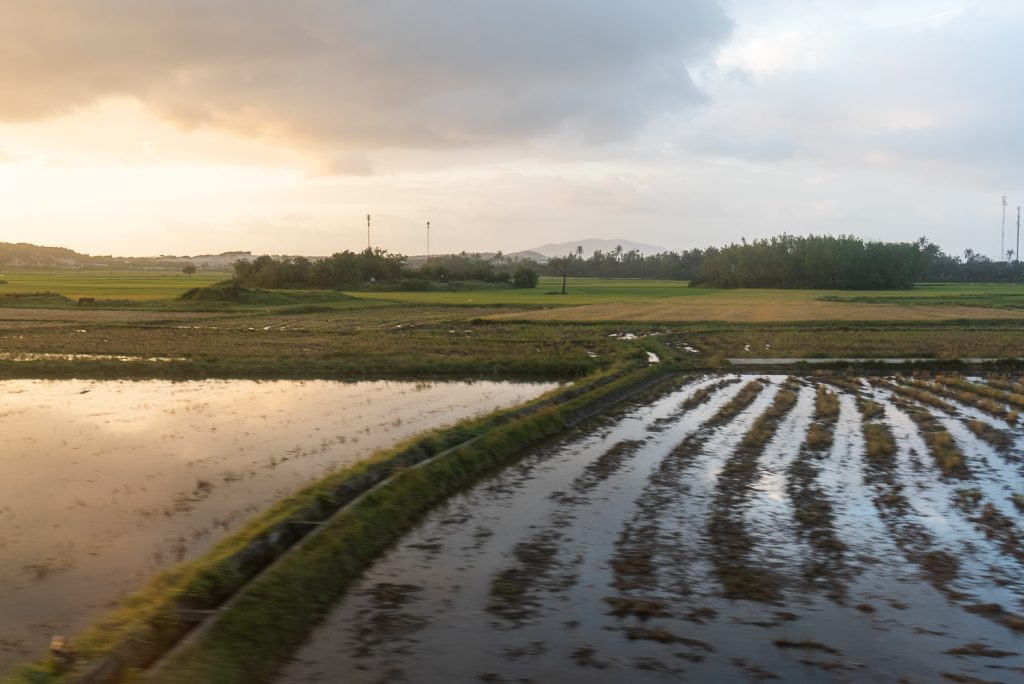
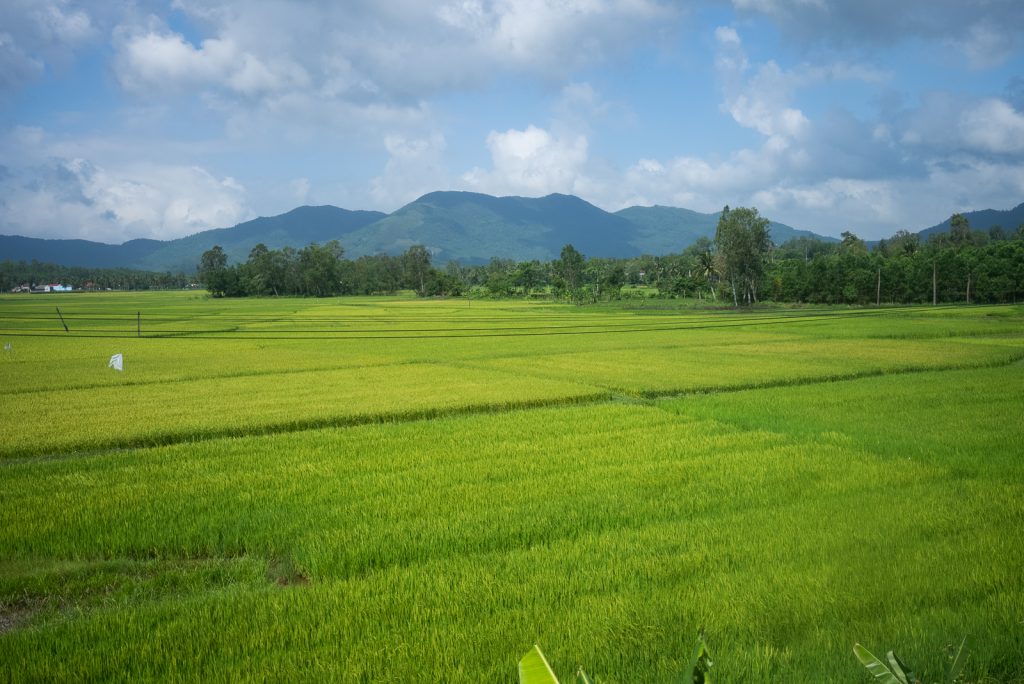
The answer is the scenery! Throughout the journey you’ll get to see so much of Vietnam that you wouldn’t see if traveling by plane. You’ll travel along the coast, through rice paddies, bustling cities, and tiny villages. Along the way you’ll be able to see water buffalo, palm trees, gorgeous beaches with sparkling blue water, and high mountain passes.
We left Ho Chi Minh City in the dark, but when we woke up, we got to watch the sunrise over the Vietnam countryside. It was magical! We spent the majority of the time on the train just staring out the window.


Getting off at your destination
As the train approaches each stop, the conductor will come over the speaker system and announce the next stop. They usually do this well in advance, starting at least an hour ahead of time. This gives you time to get your things together so you can be ready to get off.
The staff know who gets off at what stop, so they will also come by your cabin and announce your stop is coming up.
At some stops the train isn’t stopped for very long, so make sure you’re ready and by the door to get off quickly.
Frequently asked questions about Vietnam sleeper trains

Are Vietnam sleeper trains clean?
We have shared some of the less clean parts of the train, but overall the train was pretty clean. Our sheets seemed clean and our room itself didn’t have any trash on the floor. The hallways were kept pretty clean as well!
We have read that the trains get cleaned at the beginning and end of the line (for example Ho Chi Minh City and Hanoi). So it was the cleanest when we first got on the train in Ho Chi Minh City. If you get on outside of these two cities, the train may not be as clean and your bedding might not be fresh.
The train does get lightly cleaned along the ride, but it isn’t very frequent. We did see the train staff clean rooms a bit when people got off the train. They also came by and swept the floor once or twice.
What is it like sleeping on a sleeper train in Vietnam?
Even though the trains are called “sleeper” trains, with the engine noise, stops, other passengers moving about, and the rocking and jerking of the train, it’s sometimes difficult to actually sleep.
If you’re a really deep sleeper, you may not have a ton of issues sleeping. For us, we did struggle a bit with the movement, fear of cockroaches, and the air conditioning not working right. But we went into our Vietnam sleeper train experience expecting to be uncomfortable at times, so for us, it wasn’t a huge deal. We made sure that we could rest for the rest of the day once arriving!
As for the beds themselves, they are moderately soft and comfortable. Adam is 5’11” and he had just enough room in the bed.
Are Vietnam sleeper trains safe?
We didn’t experience any sketchy or unsafe behavior on the train, but have read stories that in the past, people would come on at the stops and steal from passengers. However, this doesn’t happen very often anymore. We felt 100% safe on the train. But it’s still good to be aware of the potential risks and be alert.
If you can, we highly suggest getting a private cabin and locking the door while you’re in the cabin.
If you don’t get a private cabin:
- Keep your belongs close and keep your valuables next to you
- Have one person stay in the room (if traveling with someone) when the other leaves
- If you have a lock on your luggage, keep it locked
- Keep your door locked
Things to know when riding a Vietnam sleeper train

Purchase your train tickets in advance
It’s best to buy your tickets in advance. If you wait until you get to the train station on the day of your departure, your options will likely be very limited.
Get to the train station early
You’ll want to get to the train station with plenty of time to spare, just in case there is an issue with your ticket, the train, etc. We got to the train about an hour in advance, which was more than enough time. At the station there is a seating area, some food options, and restrooms.
Try to arrange your ride from the train station beforehand
As soon as you walk out of the train station you will see lots of taxi drivers waiting to take people where they need to go. These taxis are an option, however getting into a random taxi could be walking into a scam.
If you’re staying at a hotel or homestay, we recommend asking them to arrange a pick up for you. You can also order a Grab ride once you arrive. We decided to just get a Grab and it was more expensive than the taxi our hotel quoted us. So we would suggest having them coordinate for you if you can!
Pack a day bag
To avoid having to drag your big suitcase out every time you need something, try to keep your most used/daily items in a smaller bag!
Your train will likely be late
Our train arrived a bit later than was advertised and we’ve read this is a common occurrence. Because of this, don’t plan a tight schedule soon after arriving at your destination, in case you arrive late.
What should you bring on a Vietnam sleeper train?

Cash
You’ll need cash to purchase food and drinks on the train.
Ear plugs and eye mask
To give yourself a better chance of sleeping success, pack ear plugs and an eye mask! Ear plugs will help drown out the noise and an eye mask will help with blocking the light.
Jacket
While our cabin’s air conditioning didn’t stay on for very long, when it was on it was very cold. We recommend bringing a jacket to stay warm in case your cabin is very cold.
Water bottle
It is not safe to drink tap water in Vietnam, so make sure to bring water bottles. You can buy these on the train, but it would be easier to have your own. We love using our hydroflask water bottle! It allows us to carry more filtered water than if we just carried plastic bottles.
Check out all the other items we suggest packing for a trip to Vietnam in our ultimate Vietnam packing list!
Snacks & easy food items
Even if your ticket has a meal, we would suggest bringing your own food, so you can eat on your own schedule. Packing bánh mì would be a delicious meal and as we mentioned, there is hot water on the train so Cup of Noodles are a good choice too.
Some snacks that are easy to bring are sesame candy (mè xửng), crispy rice (cơm cháy), chips, and fresh and dried fruits.
Outlet adapter
Make sure you bring an outlet adapter so you can charge your phone and other electronics!
Toilet paper
Possibly the most important item to bring with you on the Vietnam sleeper trains is toilet paper. You’re playing a dangerous game if you don’t bring your own!
Body wipes and hand sanitizer
You won’t find a shower on these trains, so if you want to clean yourself up a bit, be sure to take some body wipes. We also suggest some hand sanitizer as well!
Travel sheets
If you don’t feel comfortable sleeping on the sheets you can always bring some travel sheets with you. We had planned to bring this, but didn’t have enough space in our backpacks.
Entertainment
Especially on the overnight trains in Vietnam, you’ll also want to have some forms of entertainment. Be sure to download some podcasts, movies, and music, or have a deck of cards with you.
Planning a trip to Vietnam?
- eBook: The ULTIMATE guide to visiting Vietnam
- 3 week Vietnam Itinerary
- 2 week Vietnam Itinerary
- 12 best cities to visit in Vietnam
- Vietnam packing list
- The top 10+ foods to try in Vietnam
- The ULTIMATE guide to the Ha Giang Loop
- 3 days in Hanoi, Vietnam Itinerary
- 9+ AMAZING things to do in Ninh Binh
- 3 day Hoi An Itinerary
- 13+ things to do in Hoi An
- 3 day Ho Chi Minh City Itinerary
- The ULTIMATE guide to planning a trip to Vietnam
- 20+ Vietnam tips: things to know before you go!
- Watch all of our Vietnam videos
Ready to experience Vietnam by train?
Pin this guide with our Vietnam sleeper train tips for your own adventure!