
Last updated on May 18th, 2026
The Long Range Traverse in Gros Morne National Park is Newfoundland’s ULTIMATE adventure. And we’re sharing everything you need to know before tackling it!
We have been fortunate to hike some of the best trails in the world, including spending dozens of nights in the backcountry. And the Long Range Traverse in Gros Morne National Park is easily one of the best backcountry adventures you can have in Atlantic Canada!

However, there is A LOT to know before tackling this hike, including safety tips, permits, how to get to the trailhead, where to camp, and important gear. Plus it’s crucial that you have a very clear understanding of what this trail is like. It is NOT for everyone!
But we’re here to help! In this guide we’re giving you a complete rundown of the hike, so you can not only decide if it’s right for you, but also have a positive experience on the trail.

- What is the Long Range Traverse?
- Long Range Traverse Map + Stats
- Permits + Cost for the Long Range Traverse
- Things to know before you hike the Long Range Traverse
- Our Long Range Traverse Itinerary
- Day 0: Mandatory Briefing
- Day 1: Western Brook Pond to Marks Pond (LR-6)
- Day 2: Marks Pond (LR-6) to Hardings Pond (LR-8)
- Day 3: Hardings Pond (LR-8) to Ferry Gulch (LR-16)
- Day 4: Ferry Gulch to Gros Morne Mountain Trailhead
- After you finish the hike
- What to pack for the Long Range Traverse
Why trust us when planning a trip to Atlantic Canada?
We spent over 3 months traveling all around Atlantic Canada in our self-converted Sprinter van, visiting many of the popular sites, plus off the beaten path gems along the way. And instead of rushing through these areas like most people are forced to on vacation, we traveled slowly, allowing us to experience them more as locals. Because of this, we have tons of tips to help you plan your own Atlantic Canada adventure, whether it’s just for a week or for multiple months.
What is the Long Range Traverse?


The Long Range Traverse is a multi-day trek in Gros Morne National Park. It takes you through the Long Range Mountains, the northernmost section of the Appalachian Mountains. It takes you through pristine wilderness, past tons of lakes and rivers, and has multiple views of fjords, all with tons of seclusion.
However, with zero maintained trail to follow, thick tuckamore, river crossings, and wet, boggy terrain, it’s both a mental and physical challenge. During our 4 days on the trail we suffered through drenched clothes, mud up to our knees, long days of hiking, and multiple rain storms. And past hikers have reported crazy bugs and tent breaking winds (thankfully we didn’t experience this)!
Because of this, the trail is NOT for everyone. We would highly advise avoiding this hike if you’re a beginner backpacker (do NOT make this your first backpacking trip) or if poor weather and mud will bother you.
But if you’re an experienced backpacker, are up for an adventure, and don’t mind a little sufferfest, we highly recommend hiking the Long Range Traverse. It’s one of the best hikes in Newfoundland!
Want a better idea of what to expect? Watch our experience on the Long Range Traverse, including the highs and lows of the experience.
Long Range Traverse Map + Stats
Distance: 36.5 km (22.7 miles) point to point
Due to the lack of trail on this hike, distance may vary. We ended up tracking about 48 km (30 miles), which included a couple wrong turns and adding on the summit of Gros Morne Mountain.
Elevation Gain: 1,700 meters (5,574 feet), but with the Gros Morne Mountain addition we tracked 2,061 meters (6,765 feet)
Difficulty: Challenging, with some long days, route finding, and difficult terrain
Days Required: 3-4
Are dogs allowed? No, as they are not allowed on the boat to the trailhead. We boarded our dog Kona at Mike’s DogTown Boarding.
Permits required? Yes, you must have a permit. We will cover this below!
Maps & GPX files: AllTrails. Parks Canada also has a GPX file you can download, although the one on their website is currently giving an error.
Permits + Cost for the Long Range Traverse

Getting a permit
You are required to have a permit to hike the Long Range Traverse. These permits are limited to 3 groups per day, with a maximum of 4 people per group, for a total of 12 permits. For 2026, permits will become available on Wednesday, February 11 at 8:30 am NT.
To get a permit, you will need to head to https://reservation.pc.gc.ca/. Once here, make sure to press the “backcountry” tab and then select “Long Range Mountains.” You will then be able to select your dates and party size. For dates, we suggest adding an extra day from what you think you’ll spend, just in case you encounter poor conditions.
After you select your dates and party size, you will then be taken to a page with a map. On this map, make sure to select “Long Range Traverse” (not Northern Traverse or Combined Northern and Long Range Traverse).
The cost for the Long Range Traverse is $112.00 CAD ($78 USD) per person. This price does not change if you spend 3 days vs. 4 days on the hike.
Boat Tour

In addition to the permit fee, you will also need to pay for the Western Brook Pond Boat Tour, which is how you get to the trailhead.
They offer a one way fare specifically for Long Range Traverse hikers, which costs $50 CAD ($35 USD). To get this ticket, make sure to choose “LRT drop off” on the ticket page. We suggest choosing the 10 AM boat tour if you can, to ensure you have enough time to hike once arriving.
With both the permit and boat fees, the total cost to do the Long Range Traverse is $162 CAD ($113 USD) per person.
If you do not have two cars to do this hike, there is also an additional taxi fee to get to the Western Brook Pond at the beginning. We will share more about this later!
Things to know before you hike the Long Range Traverse

When to hike the Long Range Traverse
The Long Range Traverse is only open from June 26 until September 30. Hiking on the earlier and later ends of this timeframe may mean that there is some snow on the trail. We personally hiked the trail in mid-August and minus a couple rainstorms (which are to be expected), it was pretty perfect!
It starts and ends in different spots
The Long Range Traverse is a point to point hike, which means it starts and ends in different areas. To start the hike, you will need to get to the Western Brook Pond parking area and take a boat across the water to the trailhead.
The hike ends at the Gros Morne Mountain trailhead, which is about a 25 minute drive from the starting point. If you have two cars, you can leave a car at each trailhead. But if you’re like us and only have one car, it’s most common to leave it at the Gros Morne Mountain trailhead and take a taxi to Western Brook Pond. That way you end the hike where your car is parked!

There is NO maintained trail
As we mentioned, there is no maintained trail. This means that you will not find trail markers or a designated path to follow. It is up to you to be able to navigate yourself on this trail and understand where to go.
While a lot of the hike has a beaten down path from other hikers and is pretty easy to follow, there are also game trails mixed in, which can take you the wrong way. It is important to download the route onto a GPS device, so you can navigate yourself.
You can hire a guide
If the thought of doing a hike without a trail is daunting, you can hire a guide for the Long Range Traverse. Gros Morne Adventures and Out East Adventures offer a guided trek, with a handful of dates available. However, it does come at a pretty steep cost!
Not up for the entire trek? If you only want to see the iconic view from the top of Western Brook Pond, you can also just do that portion as a day hike or do a one night trip.
Note: It is NOT possible to do just this portion as a day hike or one night trip without a guide, as they have arrangements with the boat tour to transport hikers both ways. If you sign up for the Long Range Traverse you will have to hike out through Gros Morne Mountain.


Campground amenities
Along the Long Range Traverse you will find six designated campgrounds: Little Island Pond (LR-5), Marks Pond (LR-6), Hardings Pond (LR-8), Lower Green Island Pond (LR-11), Upper Green Island Pond (LR-12), and Ferry Gulch (LR-16).
LR-# is what different campsites and milestones are marked as on the Parks Canada GPX file.
Each of these campgrounds offers a pit toilet (which is just an open air toilet among some vegetation) and food storage lockers. They also have a handful of tent sites, but these really vary between campgrounds. Some have wooden platforms, which are SO helpful for the boggy terrain. While others just offer a cleared area to pitch a tent. All campgrounds are located near water sources, so it’s easy to fill up on water and cook.
There are also technically some legal campsites outside of the campgrounds, which you can see on the GPX file provided by Parks Canada. But we personally would advise against these, as they do not offer any food lockers, toilets, or wooden platforms. This means you will need to dig catholes to go to the bathroom, carry food storage protection, and may have a very wet tent.
Wildlife along the trail
There is a chance you’ll run into wildlife on the trail, with moose being the most common. We saw some from afar, but did not have any interactions up close. Moose can be aggressive, so please keep your distance if you see one!
There are also black bears in the park, but the park rangers told us the chances of seeing one are extremely slim. And that they are very shy and will run away instantly!
What is tuckamore?
If you’ve looked into the Long Range Traverse, you’ve likely heard of tuckamore. These are trees that are bent and shaped due to the extreme winds. It is kind of like stiff, weirdly shaped bushes, which are a huge pain in the butt to hike through. Due to how intense they are, you can get your bags stuck, items ripped off, or holes in your clothes while trying to go through them.
Thankfully, we really only encountered one trickier area with tuckamore, so it wasn’t as bad as we read! But it is something to be aware of.

Prepare for bad weather
Besides the lack of trail, the other major hurdle for this hike is the weather. And together, they make for a tricky combination. On our Long Range Traverse hike we experienced relentless rain and even a thunderstorm.
It is important that you have extra time along the trail in case bad weather arrives. Trying to hike the route in fog is dangerous, as you may not be able to properly navigate and some areas do have drop offs. We were warned that sometimes hikers have to wait out the weather for a day.
Rescues along the trail
Rescues do occur on the Long Range Traverse. However, these rescues cost a lot of money and put rescuers at risk, so they are not taken lightly. The only time you should initiate a rescue is if you are seriously injured and cannot hike further. Or if you are extremely lost.
Minor issues, like small injuries (blisters), bug bites, and bad weather DO NOT warrant a rescue. If you do have to be rescued, just know that they can take time, especially if the weather conditions are poor. So it is advised to bring extra food, just in case something happens.
Leave no trace
Before embarking on your adventure, please review the Leave No Trace principles to ensure you leave every place better than you found it, so that others can enjoy these beautiful places for many years to come!
These seven principles include planning ahead and preparing, hiking and camping on durable surfaces, disposing of waste properly (pack out what you pack in!), understanding campfire rules, respecting wildlife, and being considerate of other visitors.
Our Long Range Traverse Itinerary

Day before: Mandatory briefing with Parks Canada
First day: Western Brook Pond to Marks Pond** (12.4 km/7.7 miles)
Second day: Marks Pond to Hardings Pond (5.5 km/ 3.4 miles)
Third day: Hardings Pond to Ferry Gulch (17 km/10.5 miles)
Fourth day: Ferry Gulch to Gros Morne Mountain trailhead (8 km/5 miles) with optional Gros Morne Mountain summit (6.4 km/4 miles)
**We intended to camp at Little Island Pond the first night, but it was extremely rainy and wet and there were hardly any wooden platforms. So we made our first day a longer day and had a shorter second day.
But there are other options! You could do the hike in 3 days, following this itinerary:
Day before: Mandatory briefing with Parks Canada
First day: Western Brook Pond to Marks Pond
Second day: Marks Pond to Upper Green Island Pond
Third day: Upper Green Island Pond to Gros Morne Mountain trailhead
We personally think the Long Range Traverse is best over 4 days. With possible poor weather at times, plus campsites not being what we expected, it is nice to have a buffer. We could’ve physically done it in 3 days, but having a shorter second day was really nice and gave us the chance to enjoy the experience more instead of rushing through.
We’re breaking down our exact itinerary below with more details on our experience, plus things to know for each stretch!
Day 0: Mandatory Briefing
The Long Range Traverse begins before even hitting the trail! At 2:30 PM the day before your start date you are required to visit the Gros Morne National Park visitor centre for a briefing. During this briefing, a park ranger talks about any current conditions, areas where people typically get confused, and rescue procedures.
Back when we did the hike in 2023, this briefing was pretty intense. The ranger was basically trying to convince us not to do the hike. We believe this is in an effort to ensure you really know what you are getting into and are prepared. Personally, we found the trail to be much less intimidating than expected. But it all depends on your experience, comfort level, and the conditions you’re given.
This briefing is also when you get your permit and you can purchase your physical map at this time as well.
Lodging the night before the hike
You cannot sleep in your vehicle at the Gros Morne Mountain trailhead, so you will need lodging the night before. Here are some options nearby!
Hotels and B&Bs: Out East Adventure Centre (Rocky Harbour), Ocean View Suites (Rocky Harbour), The Rooms at Woody Point (Woody Point), and Bonne Bay Inn (Woody Point).
Vacation rentals: The Peridot Retreat(Rocky Harbour), Elephants Head RV Park & Gros Morne Glamping (Trout River), and Gros Morne Shed (Trout River).
Camping: Gros Morne National Park has5 campgrounds, plus oTENTik, primitive sites, and cabins. Outside of the park you can stay at the Water’s Edge RV Campground or Gros Morne / Norris Point KOA.
Boondocking: We boondocked along this lakemultiple times throughout our stay in Gros Morne National Park.
Day 1: Western Brook Pond to Marks Pond (LR-6)

Park your car at Gros Morne Mountain Trailhead
The first step to hiking the Long Range Traverse is to park your car at the Gros Morne Mountain trailhead. This is where your hike will end, so once you return, you can just hop in and leave.
Unless you have two cars, you will need to then take a taxi to the Western Brook Pond parking area. We hired Pittman’s Taxi to take us (we called a week or two in advance) and they were reliable and prompt. Back when we did the hike in 2023, it cost us $48 CAD ($33 USD) for the one way ride, but it may have gone up since. So make sure to ask when calling!
Western Brook Pond Boat Tour


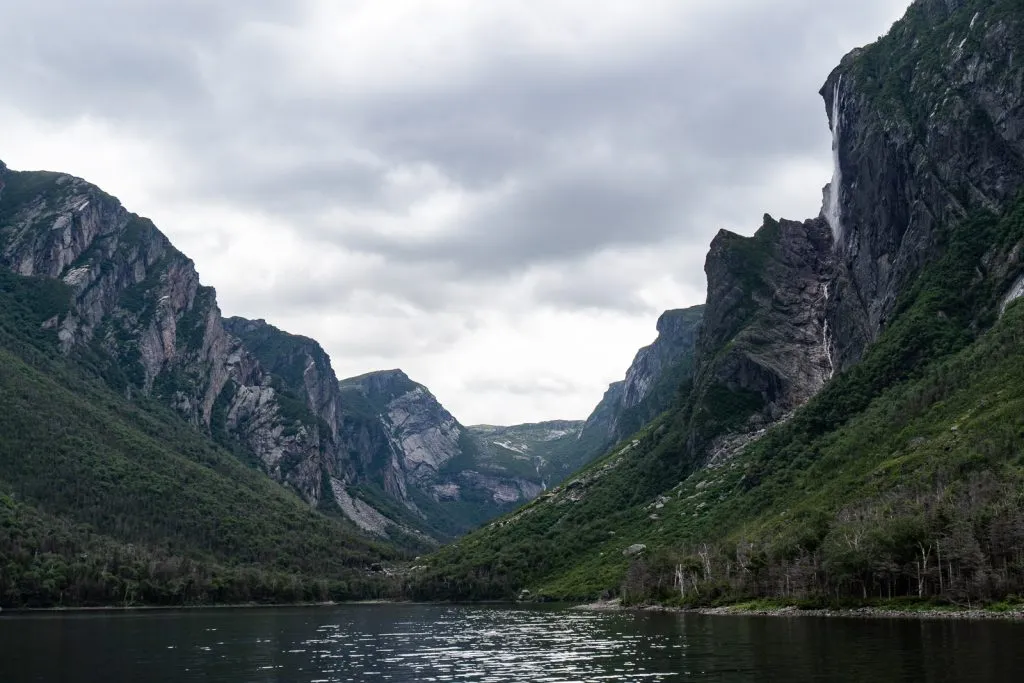

After being dropped off by the taxi, you will have about a flat 2.7 km (1.7 mile) walk from the parking area to the boat dock. Make sure to arrive a bit early so you can get your ticket to get on the boat. Long Range Traverse hikers get a special ticket, which lets the crew know you’re only doing a one way ride.
The boat ride is about one hour long and has some of the most spectacular scenery we have EVER seen! You will cruise through the 16 km long freshwater fjord, which was carved out by glaciers during the ice age 10,000 to 25,000 years ago. It has towering rock walls, with waterfalls that cascade down, reaching up to 600 meters (1968 feet) tall. We felt absolutely tiny as we cruised through here!
Along the ride, the crew will narrate and give you fun facts about the area. Make sure to stand in the bow for the best views!
Shortly before arriving, the crew will announce that it’s time to get your bags and get off the boat. And then it’s time for the adventure to begin!
Boat dock to the Western Brook Pond Overlook


Once leaving the boat dock you will go through the forest, through some extremely tall plants, up a rocky section and past a waterfall, before arriving at the iconic overlook.
This is the most trafficked part of the hike, since people do it as a guided day hike. We also were on the same boat as everyone else doing this hike, including some of the guided day and overnight groups. So route finding to the overlook was pretty easy, as we could usually see others ahead.
However, this portion of the hike was definitely the most physically demanding. And we were sweating buckets from the uphill climb and humidity by the time we made it to the overlook. But it was 1000% worth it!

When you Google “Gros Morne National Park,” the view from the Western Brook Pond Overlook is likely what you’ll see. From up here you overlook the vertical walls of the fjord, waterfalls plunging down, and the pond below. And the only way to get to it is by hiking the Long Range Traverse or going on one of the guided hikes. So it is extremely special to get to experience it!
We highly recommend having a picnic here. It’s a once in a lifetime (for many!) spot that deserves to be soaked in!
Western Brook Pond Overlook to Marks Pond (LR-6)

After leaving the overlook there is still a bit of steep uphill climbing, including across a wet rock face, before reaching the top of the Long Range plateau. From up here, you still have incredible views of the fjord. But this will be your last chance to see it, so enjoy those final moments!
The next leg of this hike takes you through the exposed terrain of the Long Range plateau. This stretch of the “trail” is relatively flat, with small sections of downhill and uphill. And along the way you’ll begin to see some of the many lakes and boggy terrain this hike is known for. Unfortunately for us, rain rolled in at this time, so our views were a bit obstructed. But from what we could tell, it was beautiful!

We originally planned to camp at Little Island Pond the first night. But due to there being no available wooden platforms (one was taken and most were broken), we opted to push on to Marks Pond (LR-6). We were continuously being rained on and everything was wet. So we hoped Marks Pond had a wooden platform. But it unfortunately did not, so we camped on the wet ground.
While the overlook just hours before had been such a high for us, this was definitely the lowest point of the trek. We set up our tent in the rain and hunkered inside for the night, thankfully waking up to sunny skies!
Day 2: Marks Pond (LR-6) to Hardings Pond (LR-8)


Our second day on the trail started with us trying to dry out our gear in the sun. Since we camped at Marks Pond, we had the choice to either do a short hike to Hardings Pond or continue further to Lower (LR-11) or Upper Green Island Pond (LR-12). Since our first day was so long and mentally taxing, we opted to do the short hike (5.5 km/ 3.4 miles) to Hardings Pond. Others in the group we started with continued on to Lower and Upper Green Island Pond (which looked very nice to camp at!). But we were glad we had an easier day. It gave us the chance to have an easier morning and also a relaxing afternoon.


Once leaving Marks Pond, we were greeted by our first river crossing of the trip! There weren’t enough rocks to walk on, so we had to just embrace it and get our feet fully submerged. Which was just the start of our feet getting completely soaked from the terrain.
Besides some water crossings, this section of the hike was also full of boggy and muddy terrain. It also was hard to find the right path at times. There were sections with multiple “trails,” some being game trails. So you really need to pay attention to the map to ensure you don’t go the wrong way.


But we successfully navigated, passing different ponds and bodies of water along the way, and arrived at Hardings Pond to an empty campground. We snagged an epic high up site with a wooden platform (woo!) that overlooked the pond. And then had an incredible afternoon reading, napping, and enjoying the view.
Day 3: Hardings Pond (LR-8) to Ferry Gulch (LR-16)


Our third day was the second most beautiful part of the trail. But also our longest day and full of obstacles! Including our first big section of tuckamore and ground that was SO wet at times it felt like a sponge. At one point our only option was to climb through tuckamore or jump over a very jiggly, muddy section. I (Kathryn) decided to jump and let’s just say I did not stick the landing. 😂 I proceeded to fall into a deep mud hole, which was pretty hilarious!
This section of the hike also had some pretty steep declines and inclines, plus our largest river crossing, between Lower and Upper Green Island Pond. This crossing was very wide and while the first half had rocks to step on, the second half was about thigh deep water. We hear that after rain, this crossing can get very intense and sometimes people have to wait it out. So keep that in mind!

Despite these challenges, the scenery on this day was phenomenal! We got to see so many lush, green rolling hills, ponds, and the ocean. But the best part was when we got near Bakeapple Pond and had a jaw dropping view of Ten Mile Pond and the steep walls that surround it.


Once leaving here, it’s about 4 km (2.5 miles) to Ferry Gulch. Parts of this hike are extremely steep and downhill and a bit tough on the knees. So having hiking poles is helpful here!
At Ferry Gulch you can find a few campsites, plus a toilet with actual walls and privacy. We chose a campsite towards the back, which had a wooden platform AND a picnic table, which felt like luxury compared to the other campsites along the trail!

Day 4: Ferry Gulch to Gros Morne Mountain Trailhead
We woke up bright and early on our final morning with the goal of summiting Gros Morne Mountain. In order to not lug all of our gear to the top, we left our tent set up and packed light packs.


Typically day hikers hike up a boulder field to get to the top of Gros Morne Mountain. But we hiked up and down the backside instead, as it was right by the campground. This route is steep, but much easier terrain, with steps along the way. And the views are fantastic! In fact, the views from this portion of the trail are even better than the summit, which is mostly just a wide open, rocky area. From the hike up we could see down into Ten Mile Pond, but from a different perspective than the day before.

We made it to the summit right as some massive clouds from a storm rolled in. After quickly snapping a photo with the sign we booked it back down the trail, getting rained on in the process. Unlike the first day, where the rain dampened our spirits, this made for a pretty memorable way to end the hike. We ended the same way we started…wet!

We got back to camp, packed up our tent, and headed down the Gros Morne Mountain Trail. It is a pretty rugged and rocky trail, so it was a bit slow moving at times. Along the way you get to see a different perspective of Gros Morne Mountain, plus a beautiful waterfall.
But the best view of all is when you catch your first glimpse of your vehicle in the parking lot and know that you accomplished the Long Range Traverse!


After you finish the hike
Once you complete the Long Range Traverse you are required to go to the Gros Morne National Park visitor centre and check in with the Parks Canada staff. This helps them know that you finished safely. If you are more than a day overdue, they may send a search crew to come find you.
What to pack for the Long Range Traverse

Since this is a multi-day backpacking route, there is a lot that you will need to bring for a safe and comfortable journey. For this hike you will want to ensure you have the 10 essentials handy, plus reliable camping gear.
You can see all of our backpacking gear here, like our tent and sleeping pads, but below are a handful of items that we want to stress bringing for this adventure.
Garmin inReach
Having a satellite communication device is crucial for this hike. If you were to need help, this would be your only way to communicate with park officials and a rescue team. We personally love our Garmin InReach Mini. Not only to have in case of emergencies, but also so we can message family as we hike to let them know we are okay. Or ask them to look up detailed weather, beyond the weather the device can pull. In the past, Parks Canada has rented devices like this for Long Range Traverse hikers, so if you do not have one, we suggest calling and asking if they still do this.
Compass & physical map
It is highly advised to bring a compass and map on this trek AND know how to use them to navigate. The park sells a physical map that you can purchase at the briefing. We purchased it, but ultimately got by just fine with the digital map. However, we still recommend buying it as backup, in case your phone dies.

Downloaded map
It is crucial to have the route downloaded onto a GPS device (phone, Garmin, etc). Parks Canada will provide you with a GPX file, which you can upload to AllTrails (what we did) or another navigation app and then download for offline use.
Make sure everyone in your group has the map downloaded, just in case a phone dies or something happens to it (like it falls into a river!). But we would advise only using one phone at a time, to save power. It’s also important to keep your phone on low power mode and airplane mode to conserve power.
Dry socks
Your feet will likely be wet the entire hike, so having dry socks to change into will be a nice relief at the end of the day. We highly recommend wearing wool socks, which do better with moisture!
Gaiters
One item that is recommended (but not required) for the Long Range Traverse are gaiters. These help keep mud and some water from getting into your shoes. We personally did not use these and just embraced the mud, but it’s something to consider!

Hiking shoes
You will want solid hiking shoes for the Long Range Traverse. However, the exact type varies depending on your preference.
I (Kathryn) wore my Lowa Renegades, which are waterproof boots. These were great for small creek crossings and shallow mud, as they kept my feet dry. However, for deep mud and river crossings, they got filled with mud and water. And since they are waterproof, they take a long time to dry. My feet were wet most of the hike and looked extremely nasty because of it.
Adam wore his Altra Lone Peak trail runners, which got wet much easier, but they also dry quicker. And they are more lightweight!
Whichever shoe you choose, make sure they are properly broken-in beforehand for the ultimate comfort.
Camp shoes
Since your shoes will likely be wet, make sure to bring a pair of flip flops or slides for camp, that way you can let your shoes dry at night and have something dry to wear.

Hiking poles
One item that was super helpful on this hike were hiking poles. Not necessarily for hiking (although they were nice for steep downhill sections), but more to test the depths of mud before putting your foot in it. They saved us quite a few times from stepping into deep holes that looked deceptively shallow!
Rain gear
There is a solid chance you will experience rain on this hike. So make sure to have a good rain jacket (we like our Patagonia Torrentshell and Columbia Watertight II), as well as a pack cover, and protection for any camera gear.
Bug protection
The bugs can be atrocious on this trail! During our briefing, the ranger showed us horrifying photos of the bug bites some people have gotten while hiking (once again, to scare us!). Thankfully during our visit in mid-August, the bugs were not bad at all. But just in case, bring bug spray, a head net, and anti-itch cream.

Plenty of food
Make sure to bring plenty of food to keep you fueled during this trek. We’d advise bringing more than you think you need, just in case the weather causes you to extend your hike an extra day.
For meals, we love Bowl & Kettle (all three flavors are 10/10!), Backpacker’s Pantry Chicken Pad Thai, Peak Refuel Chicken Coconut Curry, and Mountain House Beef Stroganoff. And for snacks, you can find a bunch of our go-to hiking snacks here!
Water filter
There are tons of water sources along the hike, so you do not need to bring a ton of water. But you will need to bring a water filter! We love our Katadyn BeFree water filter bottle since it functions as a filter and water bottle. But you can also bring a Sawyer water filter instead and filter it into any bottles or a CamelBak!
Battery chargers
Having an external battery (or two!) is a MUST to ensure your phone stays charged. Especially if you plan to use it to navigate. Don’t forget a charger cord too!
Looking for things to do once you arrive in Newfoundland?
- 12 BEST places to visit in Newfoundland from coast to coast!
- 63+ EPIC things to do in Newfoundland, Canada
- The 31 Best Hikes in Newfoundland
- 11 Best Things to Do in Gros Morne National Park in Newfoundland
- The Tablelands Trail: Hike ON the Earth’s mantle in Gros Morne
- How to visit the scenic Bottle Cove in Lark Harbour, Newfoundland
- 10 BEST things to do on the Bonavista Peninsula in Newfoundland
- 10 FUN things to do in Twillingate, Newfoundland
- Top 10 things to do in St. John’s, Newfoundland
- Get our Atlantic Canada Road Trip eBook
- Watch our Newfoundland videos
- Read all of our Newfoundland travel guides
Save this guide to hiking the Long Range Traverse in Gros Morne


